
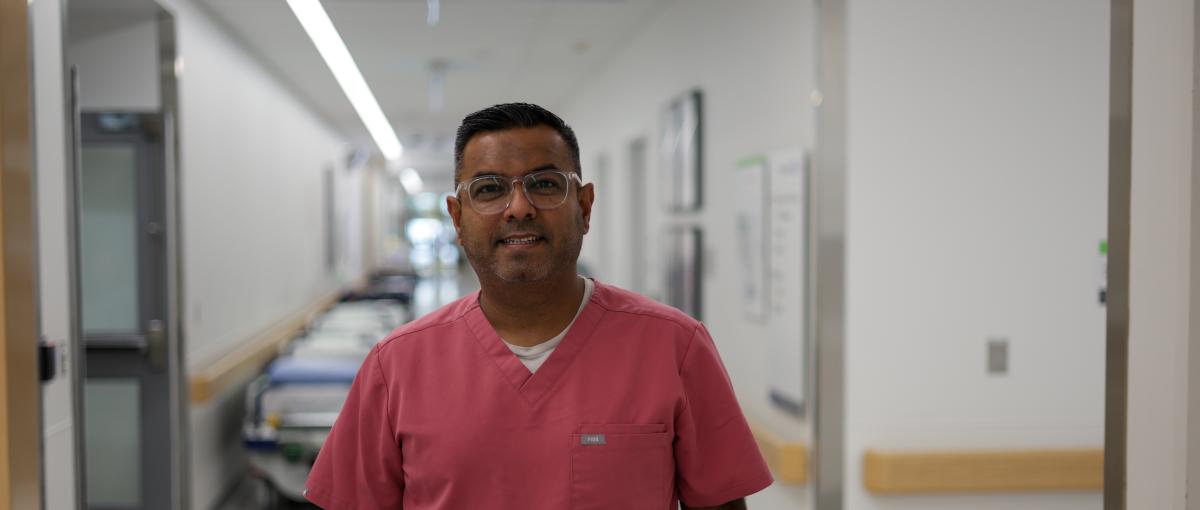
Meet Ahmed Kermalli, assistant head nurse, emergency, Misericordia Community Hospital
October 16, 2026
By Peter Rybar, social media and storytelling advisor
Ahmed Kermalli never pictured himself as a nurse. The idea came from his uncle, who gave him some practical advice: “You will always be able to put food on the table if you are a nurse.”
The words stayed with him, so he decided to give the licensed practical nurse (LPN) program a try. During his first practicum, he cared for an older patient over the course of a week.
“The experience was incredibly rewarding and helped me realize how meaningful nursing could be,” he says. “It was then that I began to see nursing as a career I could truly enjoy.”
Today, Ahmed is an assistant head nurse (AHN) in the emergency department at the Misericordia Community Hospital. He has been with Covenant Health for 22 years. He started as an LPN on a medicine ward in 2004.
Those first shifts felt overwhelming at times. The support of his team and clinical educators helped him settle in.
Ahmed soon found he was drawn to emergency nursing and to caring for critically ill patients. He wanted to grow his skills and broaden his scope of practice, so he enrolled in the Bachelor of Science in Nursing program at MacEwan University and kept working as an LPN.
“Balancing school, work and family life was challenging, and I am incredibly grateful to my wife for supporting me throughout that journey,” he says.
His managers and colleagues helped too. They traded shifts with him and arranged time off for exams and practicums. Ahmed was also among the first recipients of the Covenant Health Staff Education Fund, which helped him go back to school and finish his degree. Earlier in his career, Covenant had provided the documentation he needed for his immigration process in Canada.
He began working as a registered nurse (RN) in 2012. Within a year, he took on a temporary unit manager role on the medicine ward. He enjoyed leading, but he missed the bedside. In 2014, he moved fully into emergency nursing.
As his experience grew, he set his sights on becoming an AHN. He took on the role in 2022. It let him lead the team “while remaining connected to bedside nursing and continuing to do what I love as an RN.”
“An assistant head nurse in the emergency department wears many hats, often all at once!” he says.
On any shift, Ahmed manages patient flow and coordinates care for patients arriving by ambulance or walking in. He helps sort out problems and conflicts as they come up, and he steps in when staff need a hand. When the unit managers aren’t there, he makes sure the department is staffed and running as smoothly as possible.
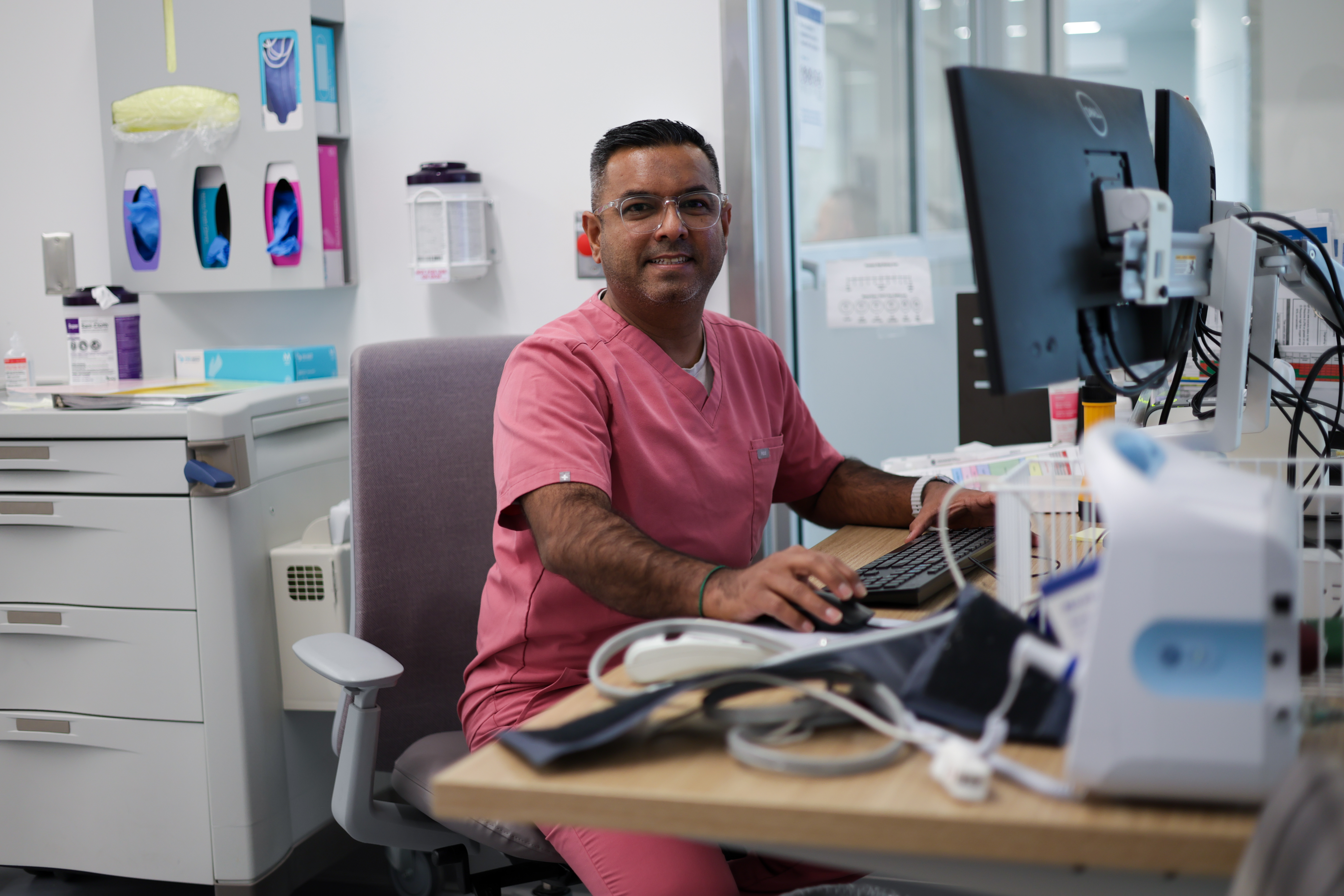
The biggest adjustment was learning when to step back and let the team work, and when to step in and help. Staying calm under pressure matters too.
“As a leader, your reactions can influence how the team responds to challenging situations,” he says.
In emergency, the work rarely stops. A nurse may finish caring for one critically ill patient and move straight on to the next, with little or no time to pause and debrief.
Some shifts stay with you. In 2020, during the COVID-19 pandemic, Ahmed was part of a team resuscitating a newborn.
“Unfortunately, it did not end positively,” he says. “As a parent who had just welcomed our third child, the experience hit very close to home. It was a moment that stayed with me and reminded me of the emotional weight nurses sometimes carry.”
Much of the work that keeps the department moving happens behind the scenes. Ahmed is constantly balancing staffing, space and how sick each patient is, so the sickest patients get care quickly.
“I often compare it to a clogged sink,” he says. “You work hard to clear the blockage and get everything flowing again, only to have five more ambulances arrive within minutes, each bringing patients who need care and space.”
A lot has changed since he started. Electronic charting in Connect Care, ultrasound to help start IVs and automated chest compression devices have all changed how the team works. The heart of the job has not.
“At its core, emergency nursing is still about being there for people when they arrive at the hospital needing care, often during some of the most stressful moments of their lives,” he says.
Ahmed sees that care in his colleagues every day. He remembers an older man who was discharged late one evening. Ambulances were backed up, and there was no quick way to get him home. One of the nurses got approval for a taxi and arranged for a family member to meet him at home. She also asked the family to call back once he had arrived safely.
“The nurse looked beyond the immediate task of discharging a patient and considered what was needed to ensure his safety after leaving the hospital,” Ahmed says.
Now he’s the one others learn from. Ahmed has watched unit clerks and porters go back to school to become nurses, just as he once did while working.
“I have tremendous respect for them, because returning to school and pursuing a new career path takes courage,” he says.
He still learns from his colleagues every day. “Nursing is a profession where there is always something new to learn,” he says.
What’s kept him at Covenant Health for 22 years comes down to the people beside him.
“Covenant feels like home to me,” he says. “I am fortunate to work with fantastic, supportive colleagues and a team I genuinely look forward to seeing when I come to work.”
Ahmed once took a chance on nursing because of his uncle’s advice. Now he has some of his own: “Go for it! The journey will not always be easy, but it can be incredibly rewarding.”