

Meet Andrea Taeger, occupational therapist, St. Mary’s Hospital, Camrose
November 6, 2026
By Peter Rybar, social media and storytelling advisor
One of Andrea Taeger’s clients was thrilled the day he could ride his mower again. A couple in their 80s, both recovering from strokes, worked hard to get back to playing piano and guitar together. A woman in her 20s set a goal of making her signature cinnamon buns again, and she reached it.
“With perhaps a few modifications, and lots of hard work, it’s always inspiring to see what people can achieve,” says Andrea.
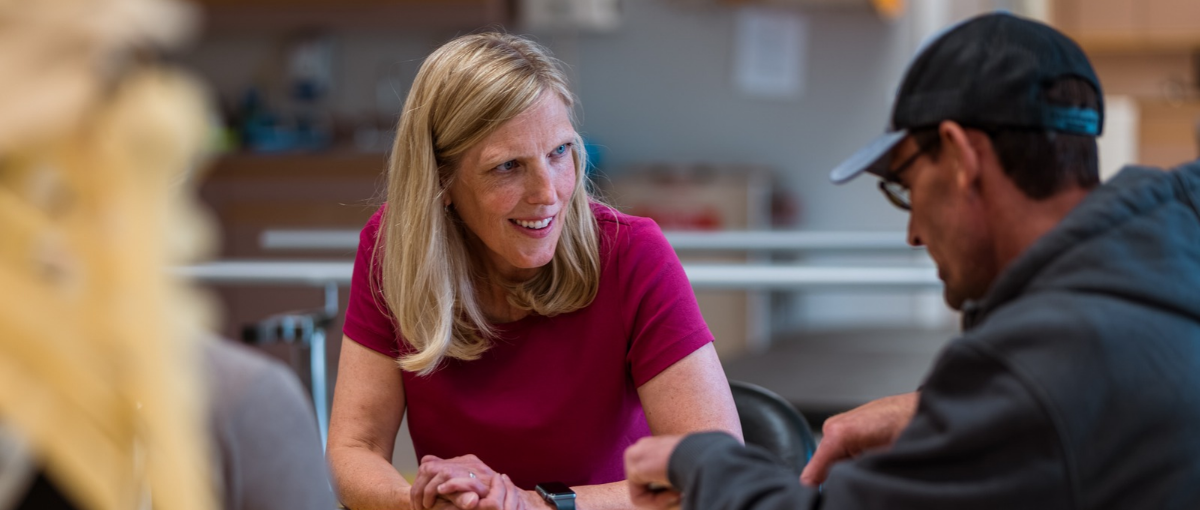
Today, Andrea is an occupational therapist (OT) at St. Mary’s Hospital in Camrose and part of the Early Supported Discharge (ESD) team, which brings rehab into the homes of people who have gone home from hospital after a stroke. She joined the team when the program started in Camrose in 2014 and has been with Covenant Health for 17 years.
A stroke can leave someone with weakness on one side of the body, or with changes in thinking or communication. Andrea helps clients find their way back to the tasks that matter in their lives, and she often has to explain what that means.
“I often explain that the word occupation refers to all the functional tasks that a person does, including self-care, leisure, work, home management,” she says. “As OTs, we help people to participate in meaningful tasks.”
That might mean changing a client’s environment, providing an assistive device or a new strategy or building skill through targeted exercises and activities. Often the fix is small. When a stroke affects someone’s dominant hand, a utensil with a built-up handle or a pair of elastic shoelaces can help them feed or dress themselves again, even if they only need it for a short time.
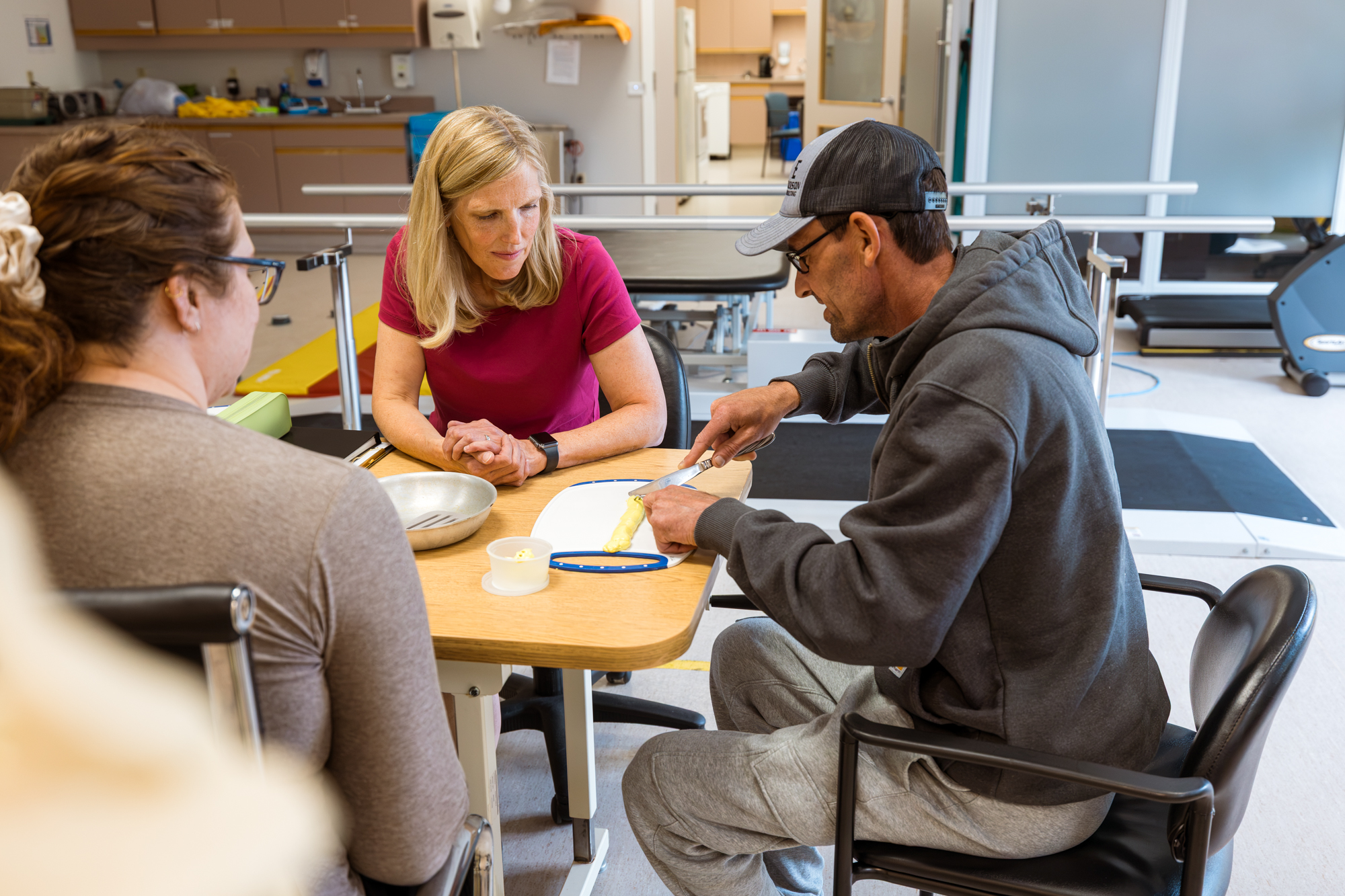
Fatigue is common after a stroke, so Andrea teaches clients new ways to save their energy.
“Things like pacing, task prioritization, and adjusting timelines and expectations can make a big difference,” she says. Those changes help people keep doing what’s important to them “without becoming totally exhausted.”
Andrea didn’t set out to become an OT. She comes from a long line of teachers and planned to go into education. While she was a student at the University of Alberta’s Augustana Campus, her roommate was exploring rehabilitation medicine, and as Andrea read through the different programs, occupational therapy caught her eye.
Her roommate, as it turned out, went on to a career in education.
Before Augustana, Andrea spent time on an international exchange in New Zealand. She earned a liberal arts degree with a focus on education, psychology and global development studies, then studied occupational therapy at the University of Alberta. After graduating, she spent a year in Quebec with the Official-Language Monitor Program, helping teach English and learning French.
Then she visited her parents in Whitehorse to hike the Chilkoot Trail and applied for a pediatric OT job.
She stayed in the Yukon for 10 years, working at the Child Development Centre with families of children up to age six. Her multidisciplinary team worked in Whitehorse and travelled to every community in the territory. During those years, she also volunteered overseas: installing shallow wells in Malawi, helping at an orphanage in India, volunteering in Thailand after the tsunami and providing OT services at a kids’ camp in Trinidad.
She moved to Alberta to take a course in medical acupuncture with Dr. Steven Kyaw Htut Aung at the University of Alberta and started working at St. Mary’s in acute care and outpatient services.
“While it was circumstance that brought me to Covenant, it is the core values of Covenant and the great people that I work with which keep me here,” she says.
Andrea’s day starts with a check-in with her team, which includes therapy assistants, a physical therapist, a speech-language pathologist, a registered nurse, a recreation therapist, a psychologist, a social worker, a clerk, a team lead and a department manager. She reviews chart notes and gets ready for the day’s visits.
“Often, I make a stop at St. Mary’s to pick up a lease vehicle and any supplies or equipment I might need, and then I’m off for the day,” she says.
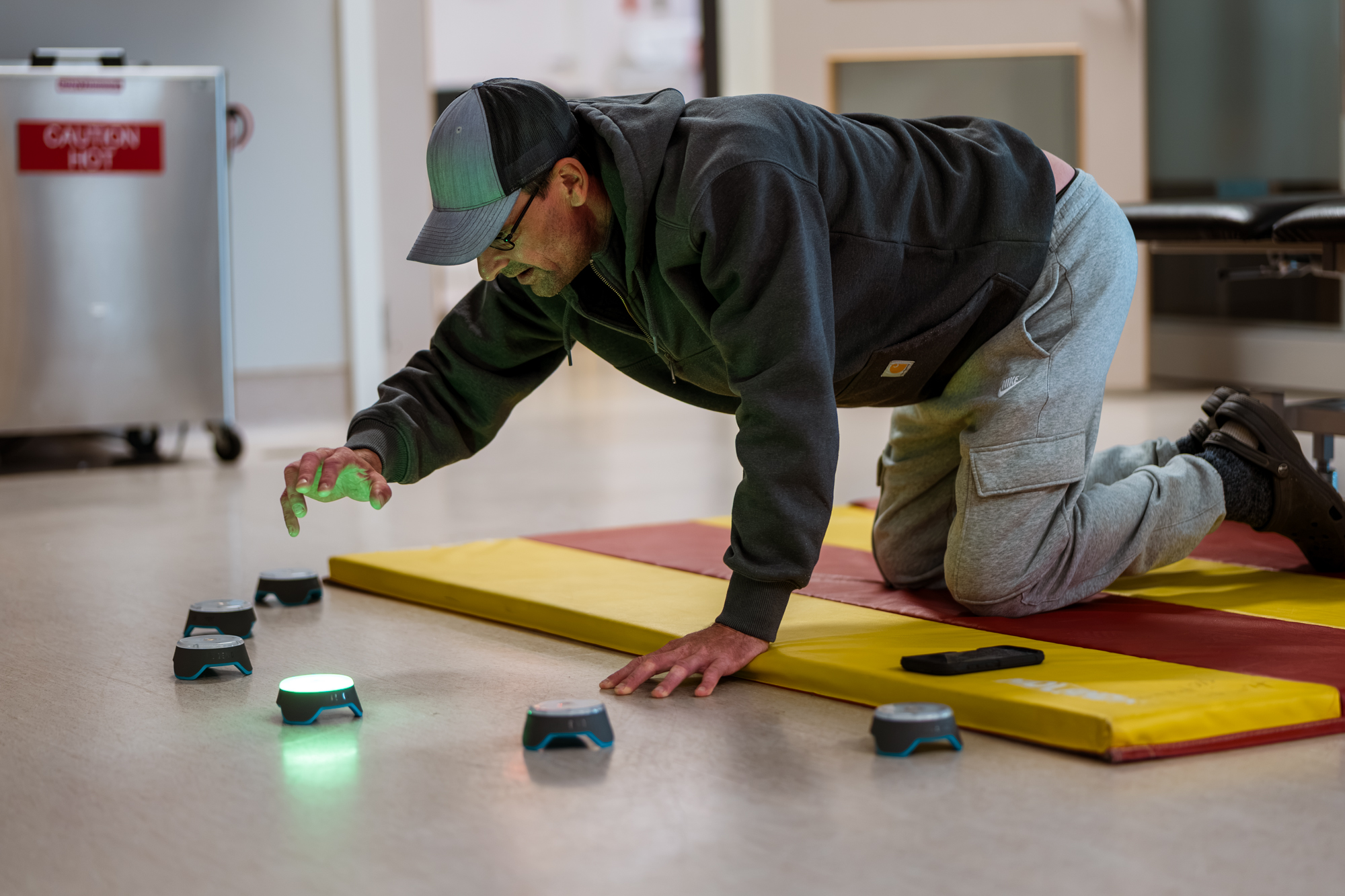
Most visits happen in clients’ homes, typically within 100 kilometres of Camrose. Some take place over Zoom, and some happen out in the community, at a library or a grocery store. She might help a client with vision loss find their way through the grocery store aisles, set up memory strategies so someone can manage their medications or give hand exercises to a person working to write, cook or dress on their own again.
What might surprise people, she says, is how far her work reaches beyond OT. On a transdisciplinary team, Andrea also helps clients with communication, balance and recreation goals.
A client’s ability to shop for groceries on their own might depend on how far they can walk, whether they can read labels or talk to the cashier and how they’ll get to the store. Everyone on the team brings their expertise to the goals the client has chosen.
Of Covenant’s values, collaboration resonates most with Andrea, and it includes the people she serves.
“Collaboration happens with clients and their families,” she says. “It becomes a partnership in which we’re all collaborating in an effort to support goal achievement.”
Andrea also works in St. Mary’s High Risk Lower Extremity Clinic, where she partners with a wound care nurse to take pressure off clients’ foot ulcers.
“Working with people who have experienced a dramatic change in their health and abilities is sometimes difficult, in that you are empathetic to their challenges and emotions,” she says.
After a tough day, she recharges with a walk, a swim, time with her husband and two kids or a chat with a friend.
She describes her team as fun, flexible and supportive.
“There is a level of respect and collaboration that I appreciate, from little things like a colleague offering to start a lease vehicle for you, to whole team collaboration in treatment planning,” she says.
Covenant has supported Andrea’s attendance at the World Stroke Congress and the Canadian Stroke Congress. She also received an education bursary from the St. Mary’s hospital board while completing a post-graduate certificate in stroke rehabilitation at the University of Alberta.
Lately, she has started working with Augustana students studying occupational therapy. Her advice to students and new grads thinking about the profession is to explore the field, from mental health and pediatrics to acute care, workers’ compensation and home care.
“The role of an OT is diverse, which provides endless opportunities to use your strengths and to expand your skills,” she says.
For OTs thinking about Covenant, her advice is simple: apply. She says Covenant is “made up of great people who exemplify the core values that Covenant is built on.”
“I’m not sure that I expected to still be here after 17 years, but the opportunities Covenant has provided have motivated me to continue working on the great teams I am proud to be a part of,” she says.
Andrea says she has learned so much from so many people over the years, including her clients.
“One thing that I would say guides my practice is the importance of asking a client, ‘What matters to you?’ instead of just, ‘What’s the matter?’”