

Meet Erin Kennedy, occupational therapist, Misericordia Community Hospital
October 27, 2026
By Peter Rybar, social media and storytelling advisor
Months after she left the Misericordia Community Hospital, a former patient walked into the hospital cafeteria. She had come back hoping to run into the staff who cared for her during her stay. Erin Kennedy was one of them.
The woman had been admitted with severe diabetic hypoglycemia that led to the loss of fingers, toes and parts of her feet. She was going through major life changes at the same time and had to relearn all her daily tasks. Erin and the team advocated for her to go to further rehab before she returned home.
“Getting to see her happy and thriving after what could have been a fatal outcome was so heartwarming,” says Erin. “She was grateful to be alive and grateful for our care during what was her most challenging time.”
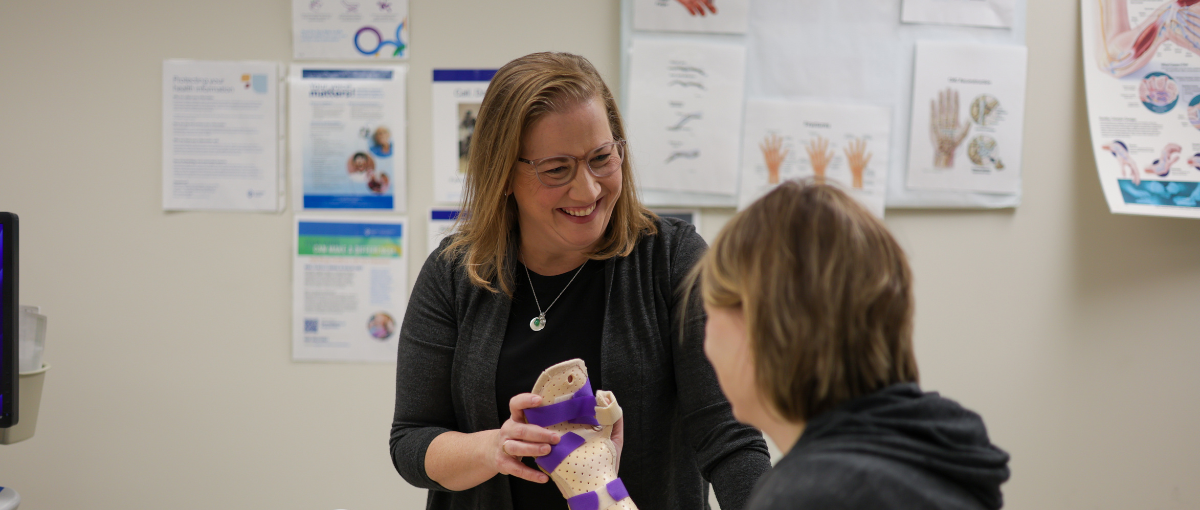
Erin is an occupational therapist (OT) in acute care at the Misericordia hospital in Edmonton. She works with adults and older patients who are struggling with everyday tasks after an injury or illness. Her profession is still one people often get wrong.
Many times a day, when she introduces herself as the OT, she hears the same joke: “But I haven’t worked in years!”
“I have never once helped someone find a job,” she says. “While some occupational therapists may do that, in the hospital that is not something we do.”
The word “occupation” covers anything that occupies your time, she says, whether that’s work, school, leisure or time with friends. Her favourite way to explain the difference between her job and her physiotherapy colleagues’ is a line she likes to borrow: “Physical therapy gets you walking down the hallway, but OT makes sure you do so with clothes on.”
Erin was a dancer when she was younger and saw a lot of people get injured. She wanted to understand the body and how to prevent injury, so she assumed physical therapy would be her path.
She took a year of general science at the University of Alberta and felt lost. Then she found the therapy assistant program at Grant MacEwan.
“Two years to a job felt way more achievable at that time,” she says.
She spent three years as a physical therapy assistant in acute care. There, she realized occupational therapy fit her personality and skills better. A physical therapist she worked with saw her potential and pushed her to keep going with school. Erin still thanks her for it.
To get into OT, Erin took the prerequisite courses she was missing through evening classes at Athabasca University. She was accepted into the University of Alberta’s occupational therapy program and earned her Bachelor of Science in Occupational Therapy.
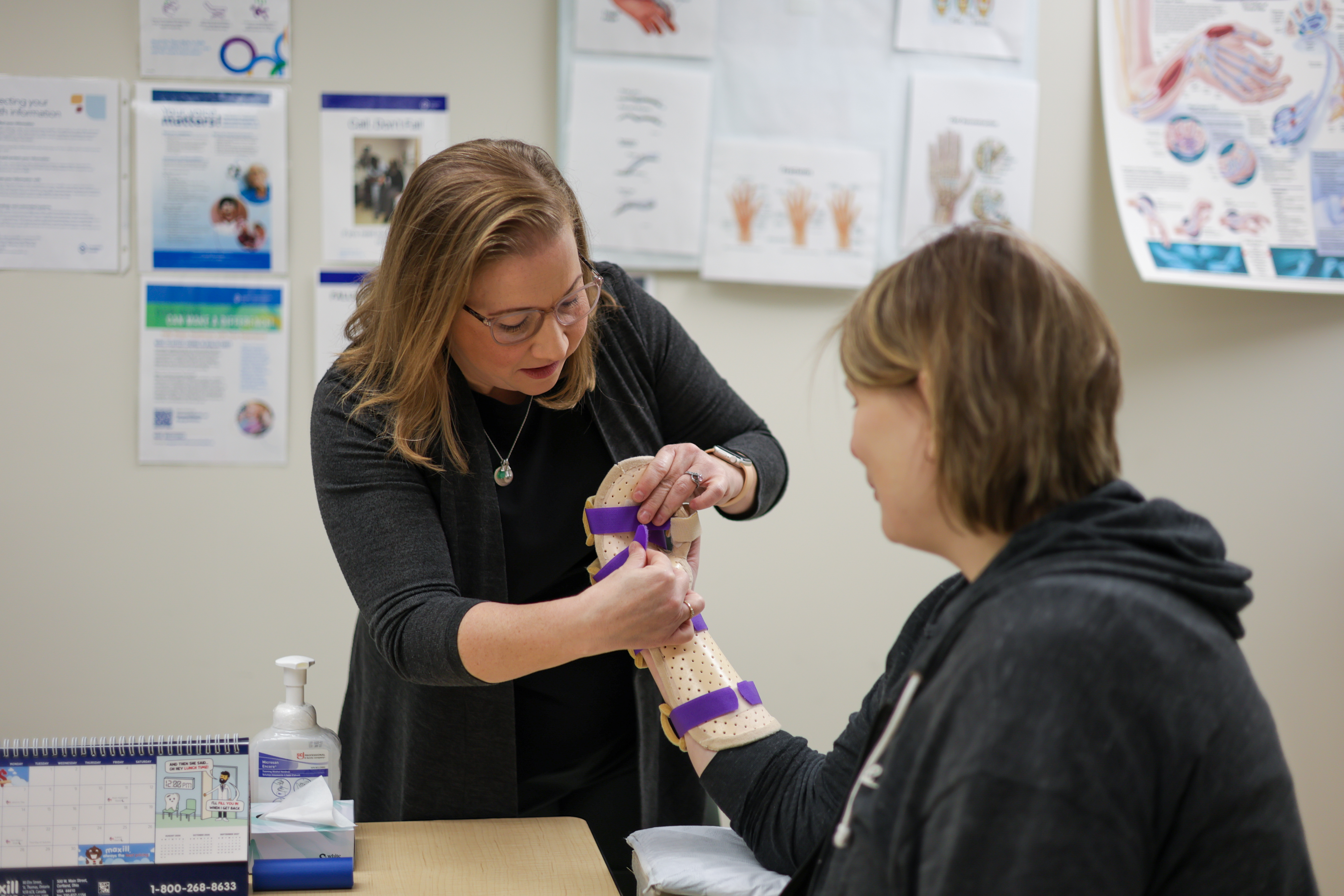
Her day starts with rounds, where the interdisciplinary team learns about the patients on the unit and decides who needs which services, and when. From there, Erin might adapt a patient’s environment, teach a different way to do a task, recommend equipment or refer them to a rehab program or home care.
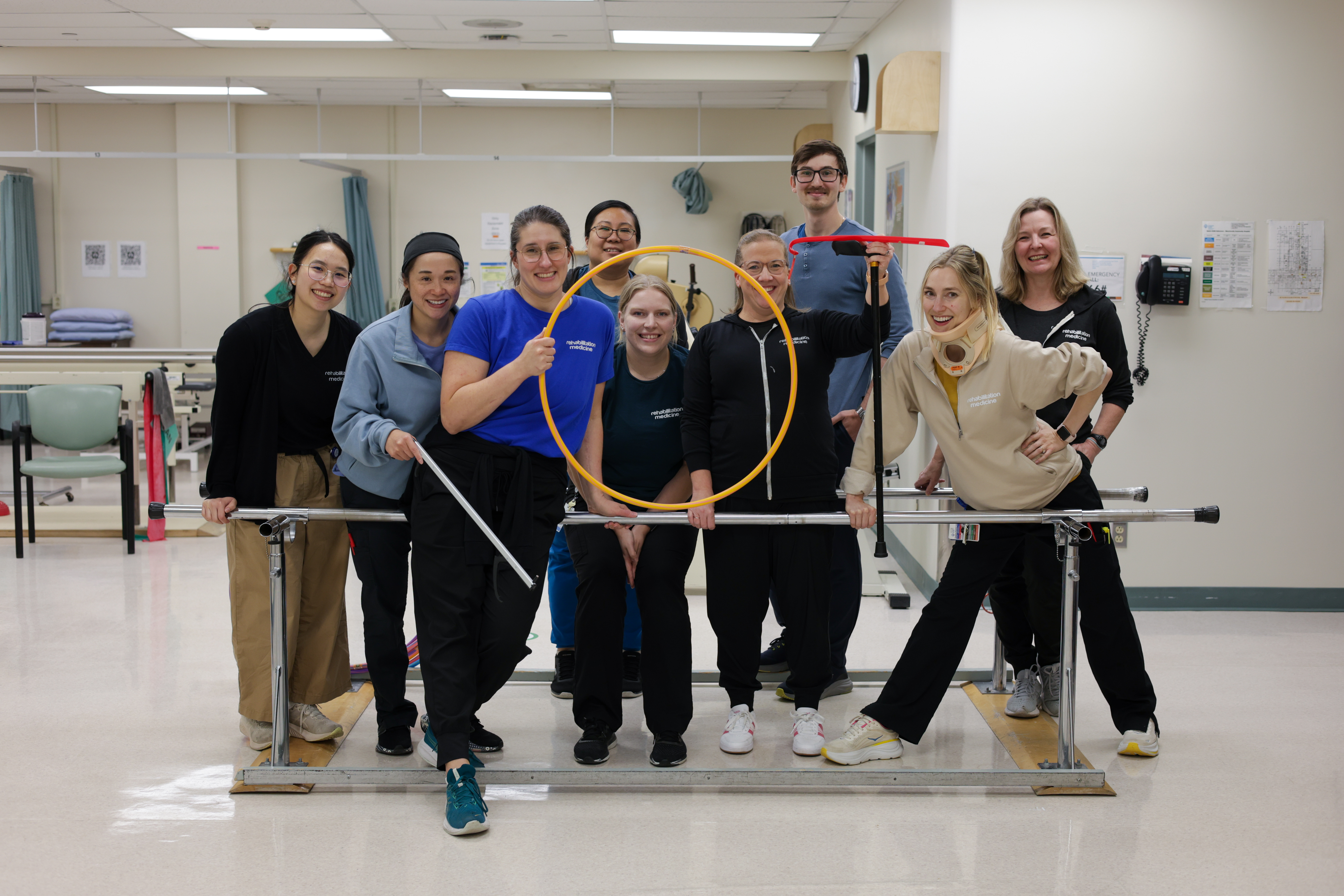
OTs at the Misericordia rotate through different areas of the hospital. Each rotation means new faces and a change of pace.
“The surprising part that people don’t always see is the creative problem solving we get to do every day,” she says. “Sometimes the simplest change, like a foam handle on a spoon, can bring a big change in function.”
Recently, a client came to Erin for a splint and mentioned her cane was hurting her other hand. Erin cut a piece of foam roll to size and secured it with Coban wrap. The padding gave the handle extra support without weakening her grip. At her next appointment, the client thanked Erin because the pain was gone.
The hardest part of the job is one most people never see.
“When someone needs help, my instinct is to jump in and help,” she says. “But sometimes, to foster independence, we need to let people fail. This allows us to assess where the gaps are.”
That can be especially hard for people who are used to doing everything on their own, she says.
She remembers one man who badly wanted to go home but would not have managed without help. His grandson was his main support and didn’t have much experience with the health system. The team arranged equipment, home care and community services so he could live on his terms in his own home.
“Both the patient and the grandson were very appreciative of how the team brought all the pieces together to make this happen,” says Erin.
OTs see patients in the middle of their lowest moments, she says. That’s why compassion matters to her more than any other part of the job.
“If we can address the situation and their experience with compassion, it really helps in establishing a positive therapeutic relationship,” she says. “That often leads to better engagement with therapy and better patient outcomes.”
The person who shaped her practice most is her dad, who passed away two years ago.
“My dad taught me generosity. Generosity with time, resources and heart,” she says. “His example shows up for me in my job every day. I often think, ‘How would he manage this situation?’ A smile, a joke, a story or lending a hand.”
Erin first chose Covenant because it was close to home and she knew a few faces there. She stays because her colleagues have become genuine friends. Over the years, Covenant has sent her to education sessions on and off site, including leadership courses and OT-specific training. She has held positions with different hours through many life changes and has always found a good work-life balance.
“Our team knows how to work hard, but we also know how to make the hard work enjoyable,” she says. “We support and care for our patients and each other.”
Her advice for students thinking about the field is to shadow an OT.
“It is so vast in its practice areas that anyone is bound to find an area of practice that suits them,” she says.
She didn’t plan on staying this long.
“I did not expect to stay here for 20 years,” she says. “I thought this was just going to be a great first job... I have enjoyed my time here and am now a permanent fixture.”