

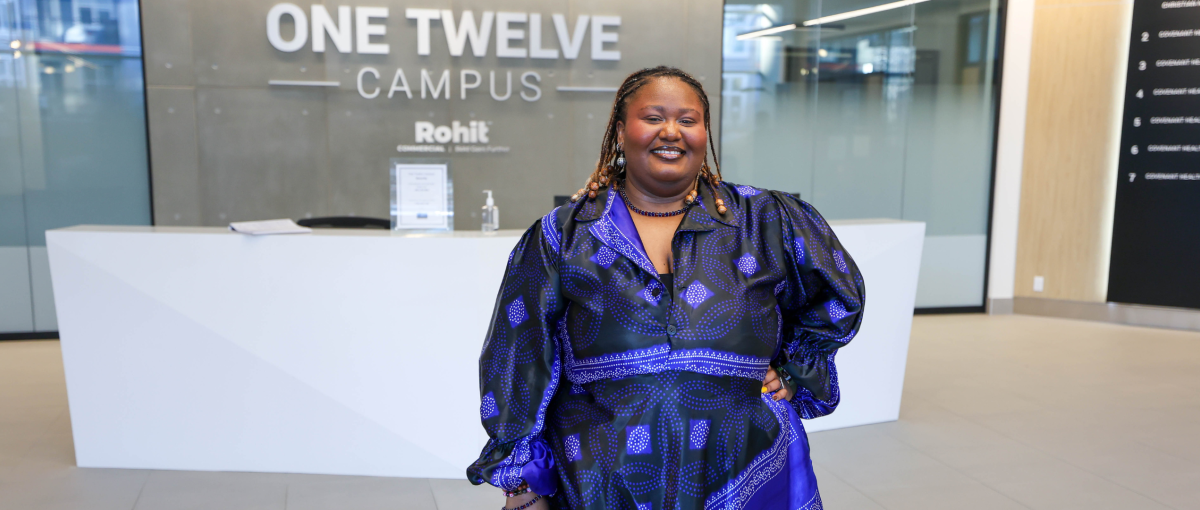
Meet Karis Nsofor, diversity, equity, inclusion and belonging consultant, talent acquisition
February 26, 2026
By Andrea Carter, communications advisor
When Karis Nsofor, a diversity, equity, inclusion and belonging consultant with Covenant Health, first encountered Black History Month in Canada, she didn’t feel the immediate personal connection some people might expect. It was 2014, only a few months after she moved to Edmonton from Nigeria to go to school. On campus, there were posters and reminders encouraging her to attend Black History Month events, but at the time, she felt unsure where she fit.
“I remember thinking, ‘Why should I be there?’” Karis says. “This is not my story.”
Growing up, Karis’s family talked openly about global Black history and culture. They were big readers, led by her mom, and conversations about identity were part of everyday life. Still, “Black” was not one of the ways she labelled herself.
“Up until then, I was where I was from,” she says. “I’m Igbo. I’m Nigerian. I’m African. I had never thought of myself as Black.”
That understanding began to shift over time as Karis built community in Edmonton and became involved in grassroots advocacy. By sharing experiences across cultures — while still honouring differences — she began to see how a shared identity could offer connection and language.
“It gives language to experiences you don’t always have words for,” she says.
Today, Karis is a member of Covenant’s Black Advisory Body, contributing her voice, lived experience and leadership to help guide meaningful change. Focused on diversity, equity and inclusion, the body helps turn reflection into action within a healthcare system that has not always felt safe or welcoming for everyone.
For Karis, Black History Month is not just about looking back.
"Celebration and acknowledgment matter. But if there’s no action behind them, they don’t mean very much."
Diversity, equity, inclusion and belonging consultant, talent acquisition
Instead, she sees this time as an opportunity to pause, reflect and ask what still needs to change.
When Karis talks about her identity, two themes come up again and again: joy and resilience. She describes Igbo culture as deeply rooted in relationship, creativity and celebration, with music, art and dance woven into everyday life. At the same time, she speaks honestly about what it means to exist in spaces that were not designed with her — or people like her — in mind and to continue to show up fully.
“You can be in a place that doesn’t want you,” she says. “That doesn’t mean you can’t work through it, making it safer for those who may come after you.”
Many of Karis’s most lasting lessons have come from the women who raised her, particularly her grandmother, who believed deeply in making space for emotion. “If she hadn’t seen me in a while, she would ask, ‘When last did you cry?’” Karis says. “If it had been too long, we would just sit and cry together.”
That lesson continues to shape how Karis shows up in her work today, especially in conversations that are heavy or emotionally demanding. “If you need to cry or scream, that’s okay,” she tells people. “If you need to pause and reflect, that’s okay too.” For Karis, belonging means being able to show emotion without wearing a mask.
“Community is finding spaces where you can just be,” she says.
That sense of belonging — or the absence of it — is especially visible in healthcare spaces. While health care is often framed as a positive system, Karis is clear that it has not been experienced that way by everyone.
“For many communities, health care has also been a place of harm, violence and loss,” she says.
That history follows people into care settings, Karis says. In her work, she often helps teams understand how policies and practices have shaped racism and discrimination in health care and why patients or staff may arrive guarded or afraid.
“Sometimes people walk in already upset,” she says. “It’s not about the individual provider. They’re seeing the system that has harmed and neglected their communities for decades.”
Representation can help reduce that burden, she says.
“When I walk into a room, I’m looking for Black women first because that’s where I feel safest,” she says. “If I don’t see that, I’m already doing extra work just to assess whether I’m safe.”
Now imagine doing that while sick, stressed or in pain, Karis says. “That’s a lot to ask of someone.” At its core, equity work is about life and death, she says. “There are people who avoid health care entirely because they don’t want to experience racism. That is not okay.”
For Karis, action starts with shared accountability. Building belonging is not just about creating warm, welcoming moments. It also means being willing to sit with discomfort, listen when someone tells you something caused harm and stay in the conversation long enough to do better. “If we truly want people to feel like they can just be, we have to do the hard work to make that possible," she says.
Before joining Covenant Health, Karis worked in the nonprofit sector, where she saw the power of grassroots work first hand. “When systems miss things, communities don’t,” she says. What has surprised her in health care is how many people inside the system see the same gaps and are actively working to address them. “That’s what gives me hope,” Karis says.
She sees that commitment in small teams, advisory bodies and colleagues pushing change within their own spheres of influence. Systems change is slow, collective work, she says.
As Karis reflects on this season of learning and recognition, she returns to one simple but powerful question. “What can I do better? How can I show up better for my Black colleagues and my Black patients?” For her, that pause is not separate from the work ahead. It is where meaningful change begins, she says.