
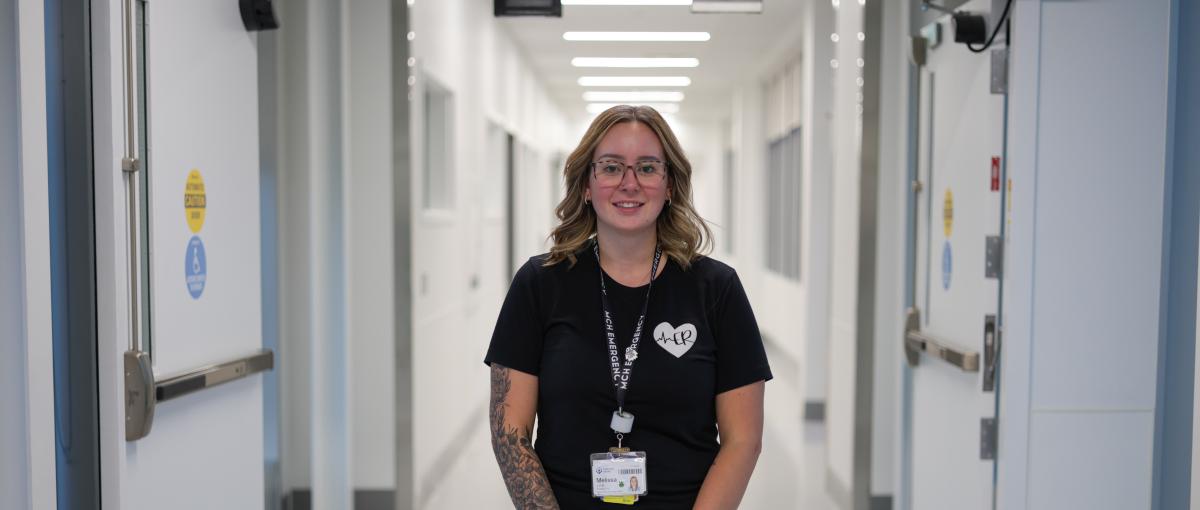
Meet Melissa Anderson, licensed practical nurse, emergency, Misericordia Community Hospital
October 13, 2026
By Peter Rybar, social media and storytelling advisor
Melissa Anderson knew the emergency department at the Misericordia Community Hospital from behind the unit clerk’s desk. She talked with patients over the counter and watched the nurses work. Then her father was brought into that same department in cardiac arrest.
“Seeing how quick the nurses moved and worked so hard to save his life, that’s what gave me the push to go back to school,” she says.
Nursing had always been her dream. Her parents, especially her dad, always encouraged her to go to school for it. She never took the leap.
“He was my biggest cheerleader,” she says. “I wanted to be that nurse who could do everything they can to save somebody’s life, or even just make a small impact on somebody’s life when they’re going through possibly one of the hardest things they could be going through.”
She also wanted to make him proud. “He pushed so hard for me to become a nurse, and with him not being here to see it, I know he’s proud of what I’ve become.”
Today, Melissa is a licensed practical nurse (LPN) working in the Misericordia’s emergency department. She’s four months into nursing and nine years into her time with Covenant Health.
She spent three years as a unit clerk in emergency before going back to school. From the desk, she saw how much critical thinking the job takes, and how fast nurses have to move.
“In emergency, you’re their first point of contact as a nurse within the health care system, and what you do for them can have a huge impact,” she says. “Sometimes it’s a life-or-death situation.”
The nurses she worked beside saw something in her too. “I’ve always been told by other nurses that I should go back to school and become a nurse, because they could see how much of a compassionate and caring person I am,” she says.
Going back to school with three young children wasn’t easy. “I don’t think there is a perfect time to go back to school,” she says. Her husband and her mom, also a nurse, helped carry the load at home. The hardest part was the time away from her family while she worked on assignments and prepared for labs and exams.
“In the end, showing my kids that I could go back to school and focus on studying set a really good example for them,” she says.
Her team helped too. She moved to a casual unit clerk position during school, picking up shifts when she could, and no one expected her to work while life was hectic. Colleagues and managers answered her questions along the way.
“They were always there if I had a question while in school, even if it was the silliest questions,” she says. “They were always willing to explain it or even show me how to do things, and that made my transition from a unit clerk to a nurse so much smoother.”
Her first shift as an LPN was what she calls “a big ball of emotions.” She knew most of her coworkers and had their support. She also knew the job had changed.
“I was going to be actually physically caring for the patients, not just talking to them over the desk,” she says. “Even though I have years of experience in the hospital and I’m known to the emergency department, I was still a new nurse.”
No two shifts in emergency look the same, Melissa says. She starts with report from the previous nurse, lays eyes on her patients and sees the sickest one first. From there it’s assessments, vital signs, medications, starting IVs and getting patients ready for exams, while new orders and new patients keep coming in.
“There’s so many different things that could happen during your shift,” she says. “Things change fast and you just have to be able to adapt.”
That pace is what keeps her in emergency. She likes making quick decisions and enjoys that there’s always a way to build her skills.
Early in her new role, on a single shift, two patients thanked Melissa for something she didn’t expect: her time. She had stayed in their rooms a few extra minutes to explain things and reassure them.
“These people are in such a vulnerable state and are in need of a lot of help, and just being kind to them goes so far,” she says. “We can be quick to do our assessments, give them their medication, clean them up and move on to the next patient. But hearing that they appreciated when I took my time with them made me realize exactly what kind of nurse I want to be.”
Recently, she cared for an elderly woman who wanted to wash up but was too weak to manage on her own. Melissa brought warm water and body wash, helped her clean up, changed her gown and made her bed with fresh sheets. It took about 10 extra minutes. The woman told Melissa she was grateful to have her as a nurse and wished she saw more nurses like her.
“That’s why I do what I do,” Melissa says.
She treats every patient the way she’d want her own family treated, and that care reaches the people at the bedside too. “That means paying attention to their spouses and their loved ones,” she says. “Small things like getting them a warm blanket or a drink go a long way.”
After nine years, what keeps Melissa at Covenant Health is the people.
“It’s working with people who are like family,” she says. “Walking down the hall, everybody smiles and says ‘good morning,’ or ‘have a good sleep’ when you’re leaving from a night shift.”
The Misericordia runs in her family. Her mom has worked there as a nurse for 39 years. “That alone tells you what an amazing place it is to work,” Melissa says.
Next, she wants acute care training so she can care for the sickest patients and work in the resuscitation rooms. She may upgrade to an RN one day. For now, she’s building her skills and spending time with her family.
For anyone considering a career in health care, her advice is simple.
“If you always thought about becoming a nurse, or working in health care has sparked your interest, just take the leap and do it,” she says. “You’ll feel so much pride and joy when you’re doing one-on-one patient care and you hear those positive comments from your patients.”