

Music therapy program brings comfort to tiny patients at the Grey Nuns neonatal intensive care unit
May 1, 2026
By Peter Rybar, social media and storytelling advisor
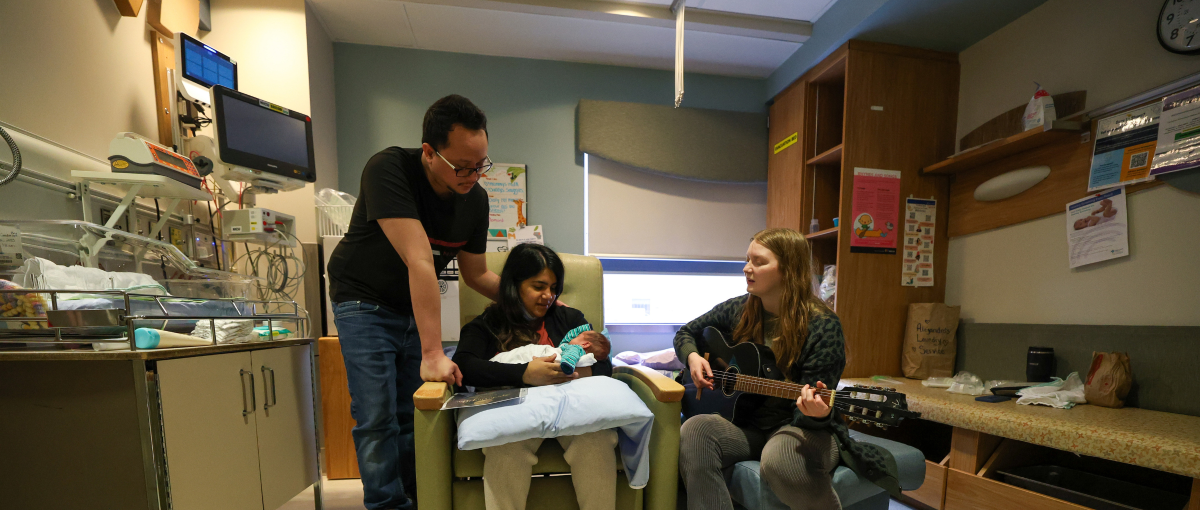
In a quiet room on unit 32 at the Grey Nuns Community Hospital, a soft lullaby drifts through the air. Maria Amores cradles her son, Alejandro, in her arms as her husband, Jeremiah, stands close beside them. The new parents sing along while music therapy student Rebecca Lappa accompanies them on guitar. Within minutes, the baby’s heart rate begins to slow. His tiny body settles. His breathing steadies.
“Music therapy is healing,” says Jeremiah. “It has made my family more united and confident in doing things together, especially as first-time parents.”
For families like the Amores, who have travelled from Fort McMurray and spent more than 50 days in the neonatal intensive care unit (NICU) while staying at Ronald McDonald House, these 15-minute sessions have become a lifeline during one of the most stressful chapters of their lives.
Rebecca, a master of music therapy student at Concordia University in Montreal, is running the first NICU music therapy program in Edmonton as her final practicum. The program offers infants and their families a form of care that reaches beyond medicine, using music to support bonding, settle babies during procedures and help parents find their footing in an unfamiliar world.
Hearing is one of the earliest developing senses in the fetus, with ear structures forming early in gestation and functional hearing emerging at around 20 to 25 weeks, says Mark Lansing, program manager for child health at the Grey Nuns hospital. By approximately 25 to 28 weeks, fetuses begin to show measurable responses to sound. Evidence suggests that recognition of the mother’s voice develops gradually in the womb and continues after birth. That makes music one of the earliest ways families can interact with their babies, especially in a NICU setting where touch and traditional bonding moments are often limited by medical needs.
“In the NICU, music therapists keep the volume of sound and length of exposure within what is appropriate for newborns,” says Mark. “It can support bonding with family, settle babies during procedures, promote restful sleep, lessen pain and help steady heart rate and breathing.”
The path to bringing music therapy to the Grey Nuns NICU was personal for Rebecca. A NICU baby herself, she was drawn to the work as a way to give back to the system that supported her as a newborn. She completed advanced practice training in the Rhythm, Breath and Lullaby NICU music therapy method in New York City in 2024 before pitching the idea to NICUs across Edmonton. Mark and his team were the only ones who responded by inviting her to deliver a presentation and share her newly acquired knowledge.
Rebecca arrived on unit 32 in early 2026 for her practicum, working Tuesdays and Thursdays from 8:30 a.m. to 3 p.m. Each session begins with a check-in with the bedside nurse, followed by a conversation with parents to understand what they need. From there, Rebecca tailors her approach to each infant, choosing instruments like guitar, gato box or ocean drum or simply using her voice. For the very premature babies, she sings softly with the isolette closed to create a sound barrier that protects their developing ears.
Rebecca says the acceptable threshold of noise for premature infants is 50 decibels or below and she keeps sessions to 10 to 15 minutes to prevent noise fatigue. Within those careful boundaries, the results have been striking.
“When the right music is used to support infants, I have seen heart rates drop from 200 beats per minute to 140 beats per minute within a single 10-minute session,” says Rebecca. “Sometimes, I have seen infants go from crying to being asleep within 15 minutes because of the music.”
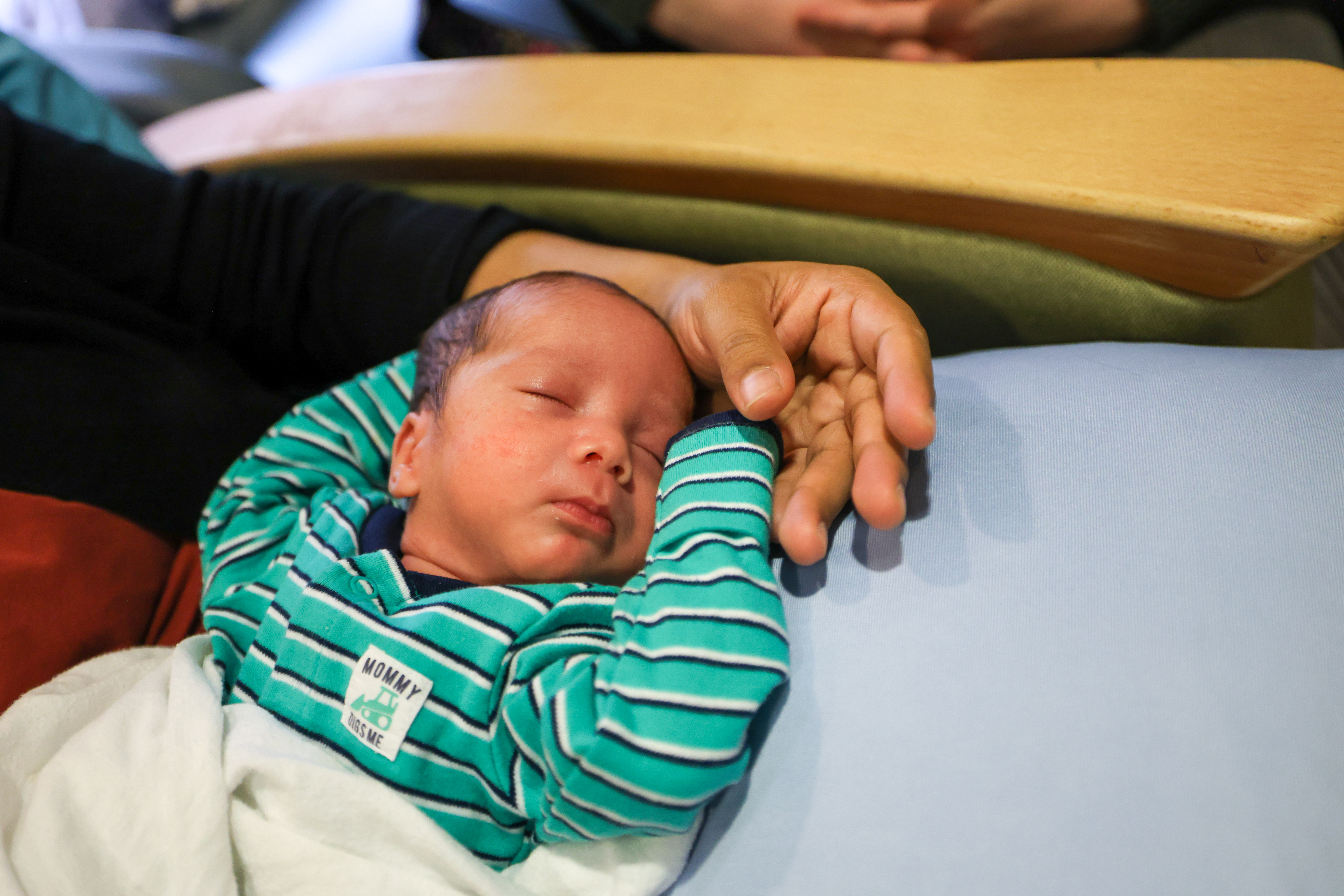
The Amores family says music therapy entered their NICU journey at just the right moment. They had noticed posters about the program on the unit and were curious. When Rebecca introduced herself at their pod and asked if she could sing with their son, Maria immediately said yes.
What followed was one of the most meaningful interventions Rebecca offers families: co-writing their “Song of Kin,” a personalized lullaby that will become a lasting piece of their child’s NICU journey. The Amores family built their Song of Kin around Wiegenlied, the lullaby Maria had sung to Alejandro when he was still in her womb. Together with Rebecca, they added new verses that captured their hopes, love and the experience of their NICU stay.
“At first, I would only hear my wife sing to Alejandro,” says Jeremiah. “Music therapy has encouraged us to sing as a family and gave me confidence that I can also help my son by singing this lullaby even when I am alone with him.”
The impact was almost immediate, says Jeremiah. Alejandro began to settle and smile when he heard the opening line, “Lullaby and goodnight.” During one particularly difficult feeding session, Rebecca arrived just as the family was struggling. They began to sing together and the atmosphere shifted.
“At the end, we were surprised that Alejandro was able to finish his first full bottle,” says Jeremiah.
For other families, the work has meant Rebecca learning songs in their first language, including Punjabi and Spanish.
“I believe that language and culture can be a huge part of music therapy,” says Rebecca, who learns songs by ear, writing out lyrics phonetically and practicing alongside the original recordings to get the pronunciation just right. “It is one way I can support bringing what families would be doing at home with their infant into the hospital setting.”
Rebecca says one mother told her that the “pronunciation was almost perfect. I can’t believe you learned a song in our language.” Another, whose sessions were entirely in Spanish, simply said, “It has been so nice to sing to my baby in my language.”
The program’s impact has also rippled out to NICU staff, says Rebecca. “The staff have responded very positively. I have often gotten comments like ‘We need more of this.’ or ‘Are you going to play for us now?’ The staff have also been instrumental in getting me consults and asking for consent from families.”
Rebecca’s practicum has wrapped up, but the hope is that the work continues, says Mark. He has submitted a funding proposal to keep music therapy on the unit, and the team is awaiting a decision.
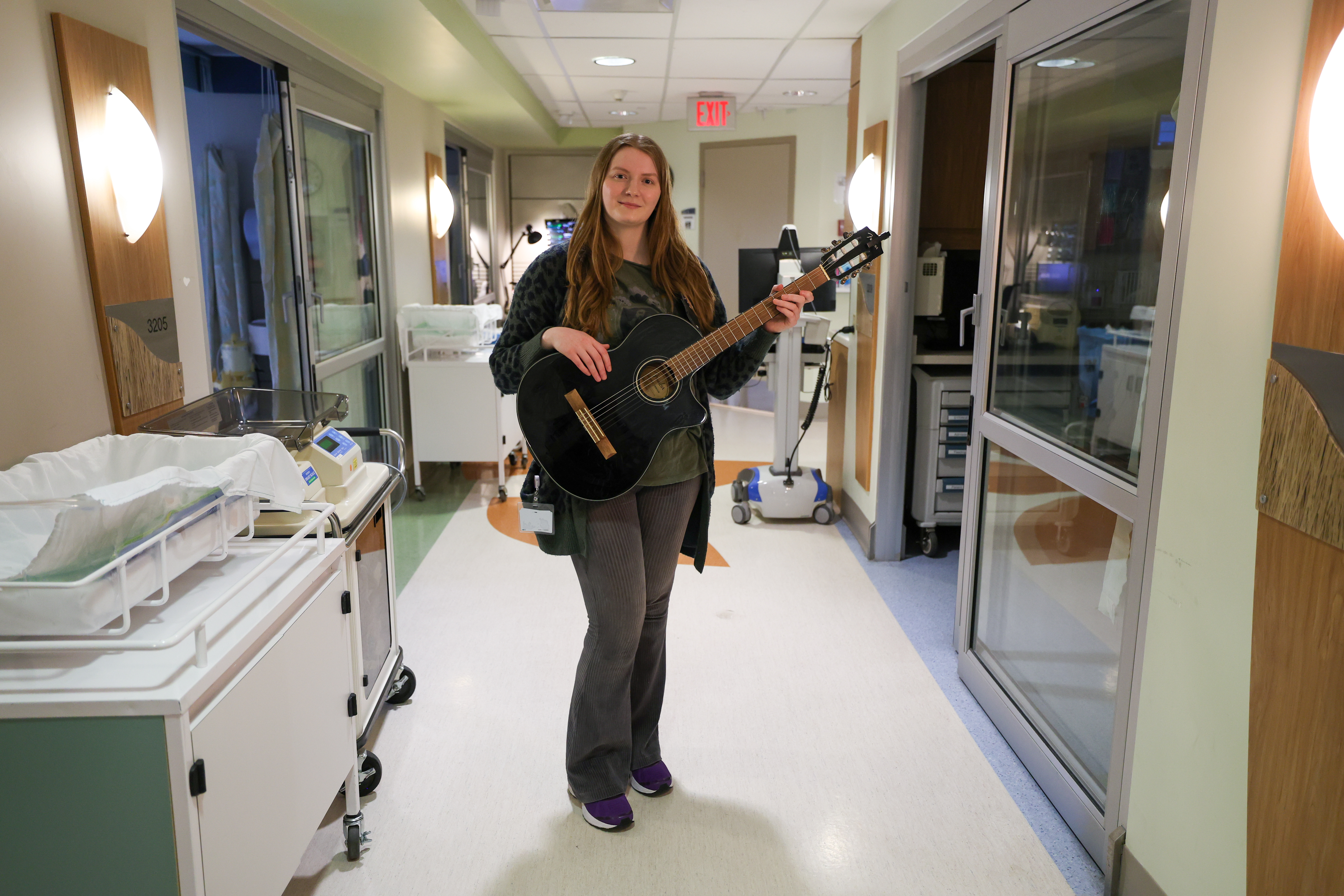
For Rebecca, who is also a local musician with deep roots in the Edmonton music community, the goal of building a permanent NICU music therapy program in Edmonton has been years in the making. One moment that has stayed with her is when a mother felt comfortable enough to open up about the struggles she was facing before and during her time in the NICU.
“None of that would have been possible without the music and its ability to transcend boundaries between people,” she says.
For Jeremiah, the experience has reshaped what the NICU stay has meant for his family.
“We are very happy that we get to create something for him and make his environment more of a homelike setting where we read books, sing songs and even compose a song about his journey in the NICU,” he says. “It reminds us that the NICU stay doesn’t have to be scary all the time. Although there are a lot of uncertainties, we still have the power to think positively and focus on our daily wins.”