

Perinatal mental health clinic marks first anniversary at Misericordia Community Hospital
May 5, 2026
By Scarlett Burnett, marketing assistant
In the weeks after her son was born, Anna, a 24-year-old psychology student, began to struggle in ways she might not have recognized herself until her family pointed them out.
“I just wasn’t my normal self,” she says. “Even simple things like getting dressed or having a shower felt really difficult.”
After reaching out to her midwife, Anna was referred to the perinatal outpatient mental health clinic at the Misericordia Community Hospital. Within a day, she received a call back and began to get support. From that point on, things began to shift, she says.
Launched a year ago in January, the perinatal mental health clinic is a new kind of outpatient service designed to support women and birthing people during pregnancy and the first year after birth. For many, this period can be both joyful and overwhelming, and mental health needs are often urgent, complex or overlooked. The perinatal outpatient mental health clinic was created to help fill that gap with timely, specialized care.
The clinic began as a pilot in January 2025. In its first year of operation, it received 395 referrals, saw 260 patients and delivered 1,260 completed visits, a number reflecting the need for this type of support.
As the pilot showed strong early results, the program expanded quickly. In March 2025, the clinic began accepting referrals from the Grey Nuns Community Hospital. In the fall, it became officially permanent, and in December 2025, it launched to the entire Edmonton Zone. Within just one year, what began as a small pilot grew into a citywide resource.
For the staff, the need driving that growth was clear. “There was a real gap in services,” says Jill Danbrook, registered social worker. “Prior to this, there weren’t a lot of supports available. It was very reactionary care. Individuals would present to the emergency department, usually in a crisis, and then we had to try and provide a solution at that point instead of preventatively.”
Carly Pain, a registered nurse who has spent her career in labour and delivery and postpartum care, says she witnessed that gap often. “Especially through COVID, a lot of mental health things came up,” she says. “Sending these women home with their babies without a lot of supports in the community, it just kind of irked me. When I heard that this program was starting, I wanted to be there.”
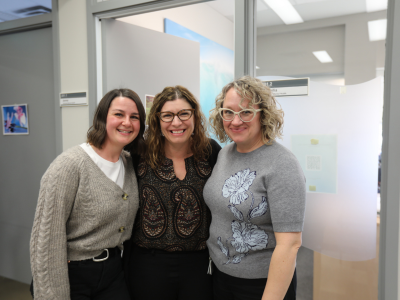
Clinic leaders Fraser Wallace and Leah McBride began building the program after recognizing how serious the consequences can be when support isn’t accessible. “We wanted to do something more specialized for outpatient mental health,” Fraser says. “There was a need for this population.” Fraser adds that suicide is one of the leading causes of maternal death in the perinatal period, highlighting why early, specialized intervention is so important.
To shape the clinic, Fraser and Leah visited three established clinics in Calgary and adapted the strongest elements for Edmonton. The early days required determination and resourcefulness, Fraser says. “We didn’t have any funding to start. There was an unused psychology position that we took and made two temporary positions from that.” Leah says that the program even relied on donated and repurposed supplies at the beginning. What they lacked in resources, they made up for through passion and a clear sense of purpose, she says.
Today, the clinic offers a wide range of supports for no fee to women and birthing people ages 18 and older who have Alberta health care, beginning at 12 weeks of gestation through one year postpartum. Patients have access to structured one-to-one therapy, group programs, perinatal psychiatry, spiritual care and wellness sessions that encourage connection and reduce isolation.
Many of the clinic’s therapeutic approaches focus on helping patients build tools they can use long after their sessions end. While the main part of the program is the one-to-one sessions, the team also runs a perinatal DBT skills group, a class designed to teach strategies for managing emotions, reducing distress and improving relationships.
Jill says connection and validation are key parts of the healing process for patients. “This program gives people a safe space, validates how they’re feeling, normalizes what they’re feeling and reassures them that they’re not alone.”
That was Anna’s experience. Through one-on-one counselling, psychiatric support and group skills sessions, she found not only care, but reassurance, she says. “They didn’t make me feel like I was crazy. They made me feel safe and supported right from the beginning.”
The clinic is also designed with practicality in mind. Patients can attend appointments with their babies, and virtual sessions are available for those facing transportation or childcare barriers. Every aspect of the program is meant to reduce obstacles to seeking help, says Jill.
The clinic’s growth over the past year reflects how essential those supports are. “At one point, we could fairly say there was no way we could keep up with these referrals,” Jill says. “It’s a need that exists, and we see it based on the numbers.”
The team has since expanded, bringing in new nurses, physicians and support staff to meet the increasing demand and creating a collaborative environment where team members can support one another as well as their patients.
Carly says one of the most rewarding parts of the work is witnessing transformation. “Seeing someone on their first visit versus their last … that change is really impactful.” She also notes the importance of helping patients challenge unrealistic societal expectations. “We’re deconstructing the idea that you have to be a perfect mom. Normalizing good enough is so important.”
Over time, the support Anna received has led to a deeper transformation that extends beyond her own experience. “For me, (the support) meant I got my life back,” she says. “My baby got his mom back, and my husband got his wife back.”
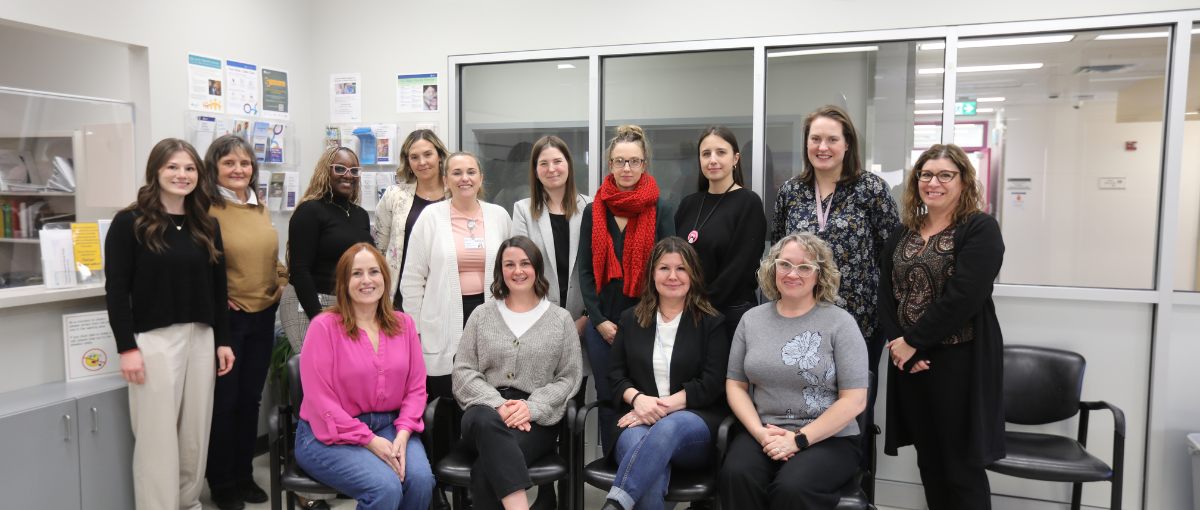
This January, members of the team paused to celebrate their first anniversary together. Over cake and conversation, they reflected on their favourite moments of the past year, the patients who made an impact on them and their significant growth. It was a chance to recognize how far the clinic has come and the difference it has already made for hundreds of families.
The work is far from over, says Fraser. The team plans to reach out to the other Covenant Health birthing sites in Edmonton and hopes to eventually expand to rural communities within Covenant Health.
For Anna, the team’s impact has been profound. “They made such a huge difference in my life,” she says. “I think I would still be struggling, or maybe not even here, if I hadn’t had that support.”