
Simulation training brings Covenant Health’s values to life
September 4, 2026
By Andrea Carter, communications advisor
When Russell Nanad, a registered nurse at the Misericordia Community Hospital, attended the annual education days for his team this year, he experienced a more comprehensive approach to simulation based training. Grounded in Covenant Health’s core values of compassion, collaboration, integrity, respect and social justice, the training offered new tools for navigating conversations and challenges that can arise in everyday care.
“The training gave me ways to deal with situations if they come up,” he said. “It was good learning and good practice.”
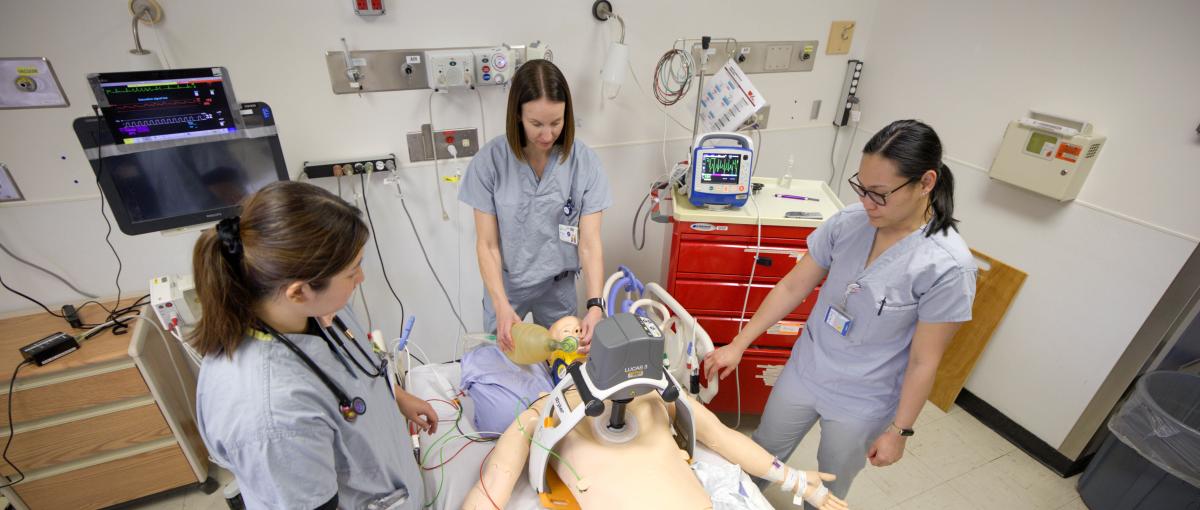
The simulation training Russell and his team experienced is a new approach to critical care staff education that helps bring Covenant Health’s values to life by aligning technical skill development with compassionate, whole person care. Launched this year as part of the Misericordia Community Hospital’s annual education days for intensive care unit (ICU) and cardiac intensive care unit (CICU) staff, the training expanded on traditional simulation based learning by incorporating scenarios focused on communication, values and patient centred care.
Simulation training uses realistic clinical scenarios to allow teams to practice responding to complex patient situations in a safe learning environment. Staff work through the scenario together and then participate in a guided debrief to reflect on what went well, what could be improved and how care can be strengthened. While simulation has long been used by Covenant Health teams to practice clinical skills, the education sessions at the Misericordia hospital introduce something new, intentionally weaving Covenant Health’s values into each learning scenario.
The idea for incorporating values into the clinical scenarios arose when Sarah Czar, clinical nurse educator, was reviewing feedback from staff following the previous year’s annual training day. Sarah noticed an opportunity to expand the focus of the sessions beyond clinical tasks.
“We were doing a great job addressing physical care,” she says. “But there was a gap when it came to discussing the broader aspects of care — things like a patient’s family, cultural context or spiritual needs.”
Building on that staff feedback, Sarah, alongside her co-facilitator Cheryl, the CICU clinical nurse educator, designed a series of scenarios pairing clinical competencies with each of Covenant Health’s core values. Each case presents a different patient situation while encouraging staff to think about the person behind the medical condition.
Throughout the training day, participants move through five different simulations, each highlighting a specific value and a unique patient experience. They practice responding not only to medical emergencies but also to situations involving language barriers, Indigenous cultural considerations and respectful care for gender-diverse patients.
By grounding each scenario in real-world experiences, the simulations create space for deeper conversations during the debrief sessions that follow, says Sarah.
“We see our teams living the values every day. But sometimes people don’t recognize it or name it. The simulation gives us the opportunity to pause and talk about what those values actually look like in practice.”
Charlotte Oostveen, a simulation lead with Covenant Health’s clinical learning team, supported the development and running of the sessions. She works with operational teams across the organization to help design simulation-based education that fits learning objectives of operational teams and ensures it reflects the diverse communities that Covenant Health serves.
The process of developing the values-based simulation sessions involved consultations with advisory groups and subject matter experts across the organization. Charlotte connected with leaders such as Indigenous health advisors and members of Covenant Health’s LGBTQ2S+ committee to ensure the scenarios were respectful, culturally safe and reflective of real patient experiences.
“Our goal was to make sure simulation represents the patients we actually care for,” says Charlotte. “By working with these partners, we were able to create scenarios that are thoughtful, inclusive and grounded in real situations our teams encounter.”
To date, more than 70 ICU and CICU team members at the Misericordia hospital have participated in the sessions and provided overwhelmingly positive feedback, says Sarah. Many staff have shared that the training helped them think more deeply about how to support patients and families in complex and sensitive situations.
Simulation builds on the knowledge and experience staff already bring to patient care, providing an opportunity to practice different approaches, explore challenging situations and strengthen strategies they can draw on in their day-to-day work.
For Sarah, that connection between learning and bedside care is what makes the work so meaningful.
“When staff can practice these situations in a safe environment, they build the confidence and language they need to bring that same approach to their patients and families,” she says.